Explainer
What Does a Leather Strop Do?
Published
Short answer
A leather strop is the last step after the stones. Pulled spine first with very light pressure, it polishes off what is left of the burr and refines the edge while removing almost no metal. It does not sharpen a dull knife. You can skip it if you end on the stone with light alternating strokes, but a strop takes the burr off more gently and keeps a sharp edge going between sharpenings.
Stropping closes almost every sharpening video, so it is fair to ask if it is a real step or a ritual. It is real, but small. A strop only works on an edge the stones have already made sharp, and what it does depends on what is on the leather: bare leather has no grit rating, while a compound adds an abrasive of a stated size. This page explains what happens to the burr and to the edge, then helps you decide if you need a strop at all.
What is a leather strop?
A leather strop for knives is a strip of firm leather glued to a rigid base: a paddle with a handle, or a block that sits on the bench like a stone. It is not the hanging strap a barber uses on a razor. Most have two faces, a smooth side and a rough (suede) side, and either can be used bare or loaded with compound. Which face does what is covered in smooth or rough side.
In the sharpening order the strop comes after the finest stone and before the knife goes back to work. On this site it is step 5 of 6: find the angle, set up the stone, raise a burr, go coarse to fine, strop, then hone and maintain.
How does a leather strop work?
Sharpening on a stone pushes up a burr: a thin wire of metal that folds over when the bevel reaches the edge. Light alternating strokes on the last stone take most of it off, but a trace often stays. The strop deals with that trace. Sharpening Supplies describes a strop as gently polishing the burr off instead of knocking it off, and gives this as one of the main reasons to own one.
Leather is softer than a stone. It gives a little under the blade, so the pressure lands right at the edge, which is why very light strokes are enough. Bare leather has no grit rating. With compound the strop becomes a very fine abrasive: Work Sharp labels its green compound 0.5 micron, finer than a JIS 8000 stone at about 1.2 micron. The sizes are compared in what grit is a leather strop.
| Job | Does a strop do it? | Notes |
|---|---|---|
| Remove the last trace of burr | Yes | One of its main jobs: the burr is polished off, not knocked off |
| Polish an edge that is already sharp | Yes | Faster with compound. Bare leather is the mildest finish |
| Keep a sharp edge going between sharpenings | Yes | A few light strokes, for as long as the edge still responds |
| Sharpen a dull knife | No | Possible in theory, but the wrong tool: use a stone of about 1000 grit |
| Repair chips or change the angle | No | That is work for a coarse stone, 240 to 400 grit |
Does a strop remove metal or only realign the edge?
Both words get used, and the makers are specific about which tool does which. Shun says honing on a steel straightens a rolled edge without removing blade material, while sharpening removes metal and puts a fresh edge on the knife. A strop sits between the two. Work Sharp describes its strop as eliminating microscopic burrs and polishing the blade while removing minimal material. So a strop does remove metal, but very little.
How little depends on the compound. According to Sharpening Supplies, compounds under 1 micron leave the strop close to plain leather, while compounds over 3 microns make it cut considerably faster. Stropping on bare leather is covered in using a strop without compound, and the two maintenance tools are compared in leather strop vs honing rod.
Is a leather strop necessary?
No. A knife that leaves a 1000 grit stone with the burr taken off by light alternating strokes is already sharp, and plenty of kitchen knives never touch a strop. What the strop adds is a cleaner finish and an easy way to keep it. Use the list to decide.
- Skip it if you sharpen a few kitchen knives on one stone of about 1000 grit and they cut the way you want afterward.
- Skip it if you keep Western kitchen knives going with a honing rod and go back to the stone when the rod stops helping.
- Get one if a burr keeps hanging on after the last stone. Light alternating strokes, then the strop, is the standard fix.
- Get one if you finish on 4000 to 8000 grit stones and want to carry the polish one step further with a fine compound.
- Get one if you want a touch-up for pocket knives or kitchen knives that takes off far less metal than going back to a stone.
Can you over strop a knife?
Not by stroke count alone. None of the makers read for this page prints a maximum number of passes, and Sharpening Supplies notes that a strop is so fine that the rounding it causes is very minimal and almost never becomes an issue on knives. What dulls an edge on a strop is how the strokes are made, not how many there are.
- Angle too steep: raising the spine above the sharpening angle polishes the very edge dull. Use the stone angle or slightly lower.
- Heavy pressure: the leather wraps around the edge. Work Sharp says to use just the weight of the knife to avoid rolling the edge.
- Rocking at the end of the stroke: Sharpening Supplies says to lift the blade straight up, because a rocking motion rounds the edge.
Note.A knife that feels duller after stropping may only be more polished: a toothy edge can feel sharper to the finger than it is. The other causes are a strop used straight after a coarse stone, and an angle that was too steep.
What you need if you decide to strop
One strop and one compound cover most knives. The listings in our strop guide show the sizes on sale: a leather face about 3 inches wide and 8 to 10 inches long carries a chef knife, and a 2 inch paddle is enough for a pocket knife. Sharpening Supplies generally recommends using a compound, on the suede side of a double-sided strop, with the smooth side left plain. Work Sharp loads the smooth side. Both arrangements work.
A strop is also one of the few sharpening tools that is simple to build: firm vegetable-tanned leather glued to a flat board. The leather, the sizes and the glue are in how to make a leather strop.
Quick answers
Short answers to the questions people ask before buying a strop. Each one is explained in a section above or on the linked page.
- What is the purpose of a leather strop? To polish off the last of the burr after the finest stone, and to refine and maintain an edge that is already sharp.
- Is a leather strop necessary? No. A knife finished on the stone with light alternating strokes is sharp. A strop gives a cleaner edge and an easy touch-up.
- How does a leather strop work? The leather, bare or with a fine compound, polishes the edge as the knife is pulled spine first with very light pressure.
- Can you over strop a knife? No stroke limit is published. A steep angle, heavy pressure or rocking the blade dulls the edge, not the number of passes.
- Do you need a leather strop to sharpen a dull knife? No, and it would not work. Sharpen on a stone of about 1000 grit first. The strop comes last.
What you need for this
 See price on AmazonAmazon
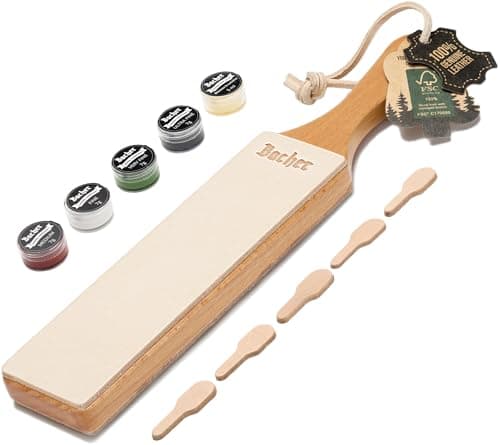
Bacher double sided strop kit, 12.6 in, 4 compounds
From Best Leather Strop for Knives: Paddle, Bench and Double Sided
 See price on AmazonAmazon
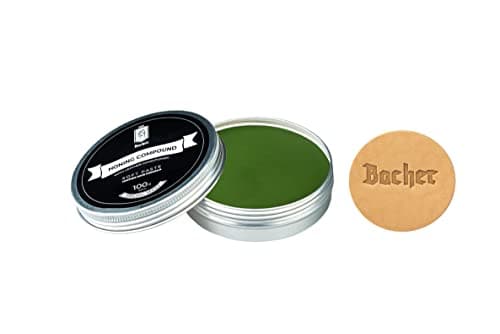
Bacher green honing paste, 8000, 3.53 oz tin
From Best Leather Strop Compound: Green Bars, Pastes and Diamond Emulsion
 See price on AmazonAmazon
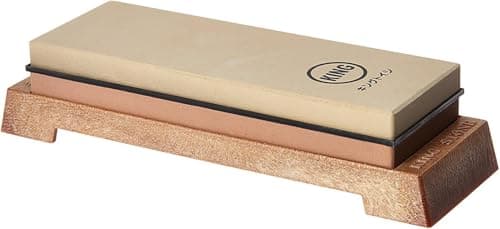
King KW65 1000/6000 combination whetstone
From Best Whetstone for Beginners: One Stone That Covers Most Knives