How-to
How to Find and Hold the Sharpening Angle on a Knife
Published
Short answer
Find the angle one of three ways: read the maker's figure, ink the bevel with a marker and see where one stroke removes the ink, or set the spine height, which is the blade width times the sine of the angle per side. A 45 mm blade at 15 degrees per side sits 11.6 mm (0.46 in) above the stone. Hold it with a locked wrist, a clip-on guide or a guided system.
Two separate problems hide in this question. The first is knowing what angle the knife already has, or should have. The second is keeping the blade at that angle for the whole session. A knife sharpened at a steady angle that is a degree or two off still gets sharp. A knife sharpened at a wobbling angle does not, because every stroke grinds a different facet and the bevel ends up rounded. So find the number once, then put the effort into holding it. All angles here are per side unless marked inclusive.
Three ways to find the sharpening angle
Start at the top of the table and move down only when a method gives no answer. Makers' figures are collected in the factory angles by brand table. The marker test needs no number at all, and the spine height turns any number into something a hand can set.
| Method | What it tells you | Use it when |
|---|---|---|
| Maker's figure | The factory angle in degrees, per side or inclusive | The brand publishes one for your knife |
| Marker test | Whether your hold matches the bevel already on the knife | There is no figure, or you want to check your hold |
| Spine height | How far to lift the spine for a chosen angle, in mm or inches | You know the angle and need to set it on the stone |
How to find the angle already on the knife: marker test
The marker test shows where the stone touches the bevel. It works on any knife and takes a couple of minutes. Use a fine stone so that a single stroke removes ink and almost no steel.
- 1
Clean and dry the blade. Color the whole bevel on both sides with a permanent marker, from heel to tip, and give the ink about 30 seconds to dry.
- 2
Prepare a stone of 1000 grit or finer as you normally would. Lay the knife on it at your best guess of the angle and take 1 light stroke along the whole edge.
- 3
Look at the bevel under a lamp. Ink gone only at the top of the bevel, away from the edge, means the hold is too low: raise the spine about 1 mm. Ink gone only at the edge means it is too high: lower the spine.
- 4
Ink the bevel again and repeat, 1 stroke at a time, until a single stroke clears the ink across the full width of the bevel. That hold is the angle the knife was ground at.
- 5
To put a number on it, keep the knife in that position and measure the height of the spine at the heel with a ruler. On a blade 45 mm wide, a spine 15.4 mm up means 20 degrees per side.
How to measure a sharpening angle as a spine height
With the edge on the stone, the blade is the long side of a right triangle and the lift of the spine is the short side. So the spine height is the blade width times the sine of the angle per side. Multiply your blade width by the figure in the table. The knife sharpening angle calculator does the same sum for any width and also runs it backward, from a measured height to an angle.
| Angle per side | Multiply blade width by | 45 mm blade | 1 3/4 in blade |
|---|---|---|---|
| 10 degrees | 0.174 | 7.8 mm | 0.30 in |
| 15 degrees | 0.259 | 11.6 mm | 0.45 in |
| 17 degrees | 0.292 | 13.2 mm | 0.51 in |
| 20 degrees | 0.342 | 15.4 mm | 0.60 in |
| 22 degrees | 0.375 | 16.9 mm | 0.66 in |
| 25 degrees | 0.423 | 19.0 mm | 0.74 in |
- 1
Measure the blade width at the heel, from the edge straight across to the spine. A chef's knife might measure 45 mm (about 1 3/4 in), a pocket knife 20 to 25 mm.
- 2
Multiply by the figure for your angle. For 15 degrees per side on a 45 mm blade: 45 x 0.259 = 11.6 mm, or 0.46 in.
- 3
Stand a small ruler upright on the stone beside the heel, or cut a wood or card block to that height. Put the edge on the stone and lift the spine until its middle is level with 11.6 mm.
- 4
Hold that position for 5 seconds so the hand learns it, take the block away, and start sharpening. Set the height again each time you turn the knife over.
Note.A block placed under the spine fills the gap below it, which is smaller than the height to the middle. With a spine 2.5 mm thick, the 45 mm blade at 15 degrees needs a 10.4 mm block, not 11.6 mm.
How to maintain the angle when sharpening a knife
Freehand, the angle is kept by the arms, not the fingers. Grip the handle with the thumb on the flat of the blade, lock the wrist, and move the knife from the elbow and shoulder so the lift of the spine cannot change during the stroke. Rest two or three fingers of the other hand on the flat, behind the edge, to keep the bevel pressed down. Along the curve toward the tip, raise the handle a little so the edge stays in contact.
Two tools take over part of that work. Both are worth it for a first set of knives or for small blades, where a 1 mm error is a big share of the height.
| Method | How it holds the angle | Limit |
|---|---|---|
| Locked wrist | The set spine height is kept by a stiff wrist and arm movement | Takes practice. Check with the marker every few strokes at first |
| Clip-on angle guide | A clip on the spine rides on the stone and fixes the lift | The lift is fixed, so a wide blade gets a lower angle than a narrow one |
| Guided system | A clamp and rod, or preset stones, fix the angle itself | Slower to set up. Read whether its scale is per side or inclusive |
Per side or inclusive: check before you set anything
A sharpening angle is per side unless it is marked inclusive. Per side is the angle between the blade and the stone. Inclusive is both sides added together, so 15 per side is 30 inclusive. Makers use both forms. Benchmade prints 30 to 35 degrees inclusive for most of its knives, and the Spyderco Sharpmaker is labelled 30 and 40 degrees for settings that are 15 and 20 per side. Halve an inclusive figure before you multiply it into a spine height.
How to tell the angle is right and holding steady
The stone leaves evidence. Stop early on the first side and look at the bevel under a lamp before going further. These four signs show that the angle is right and that it has not moved.
- The marker ink is gone across the full width of the bevel, from heel to tip, with none left at the edge or at the top.
- The bevel is one flat, even band of the same width along the straight part of the blade. A rounded or two-step bevel means the angle moved.
- A burr can be felt along the whole opposite side, heel to tip. Feel across the edge from the spine outward, never along it.
- The scratch pattern from the stone runs evenly over the bevel. A second bright line right at the edge means the last strokes were steeper than the rest.
Which angle to aim for when the maker gives none
Match the existing bevel with the marker test first. If the bevel is too worn or damaged to read, go by knife type: Western kitchen knives run 14 to 20 degrees per side, Japanese double-bevel knives 10 to 17, pocket knives 15 to 22, and hunting knives 20 to 25. Each has its own page: kitchen knives, Japanese knives and pocket knives. Every other type is in the knife sharpening angle chart.
Quick answers
Short answers on finding, measuring and keeping a sharpening angle. All figures are degrees per side unless marked inclusive.
- How to determine the sharpening angle of a knife blade? Use the maker's figure, or ink the bevel and adjust your hold until one stroke removes all the ink.
- How to measure a knife sharpening angle? Measure the spine height and the blade width. The angle per side is the arcsine of height divided by width.
- How to maintain the angle when sharpening a knife? Lock the wrist and move from the elbow and shoulder, or use a clip-on guide or a guided system.
- How to get the correct angle when sharpening a knife? Set the spine height first: blade width times 0.259 for 15 degrees, times 0.342 for 20.
- Does the angle have to be exact? No. A steady angle matters more than an exact one. Benchmade's care guide makes the same point.
What you need for this
 See price on AmazonAmazon
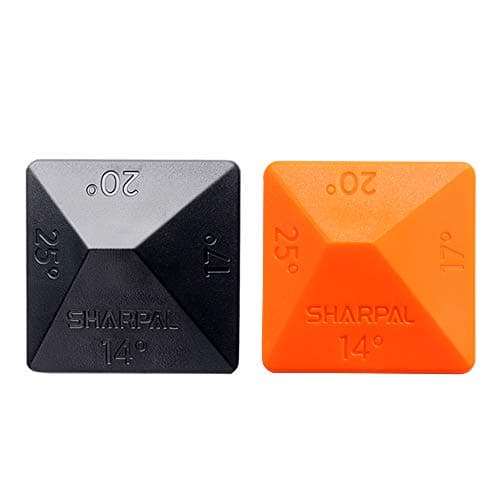
SHARPAL 196N angle pyramid guides, 2-pack
From Best Knife Sharpening Angle Guides: Clips, Wedges and Rails
 See price on AmazonAmazon
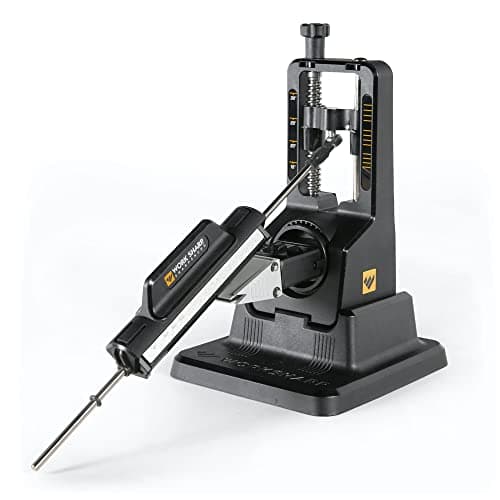
Work Sharp Precision Adjust knife sharpener kit
 See price on AmazonAmazon
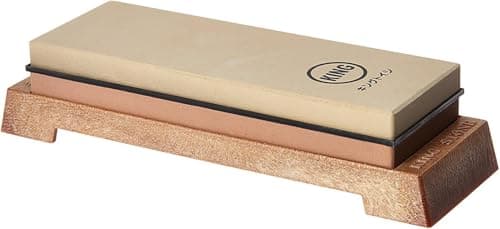
King KW65 1000/6000 combination whetstone
From Best Whetstone for Beginners: One Stone That Covers Most Knives